
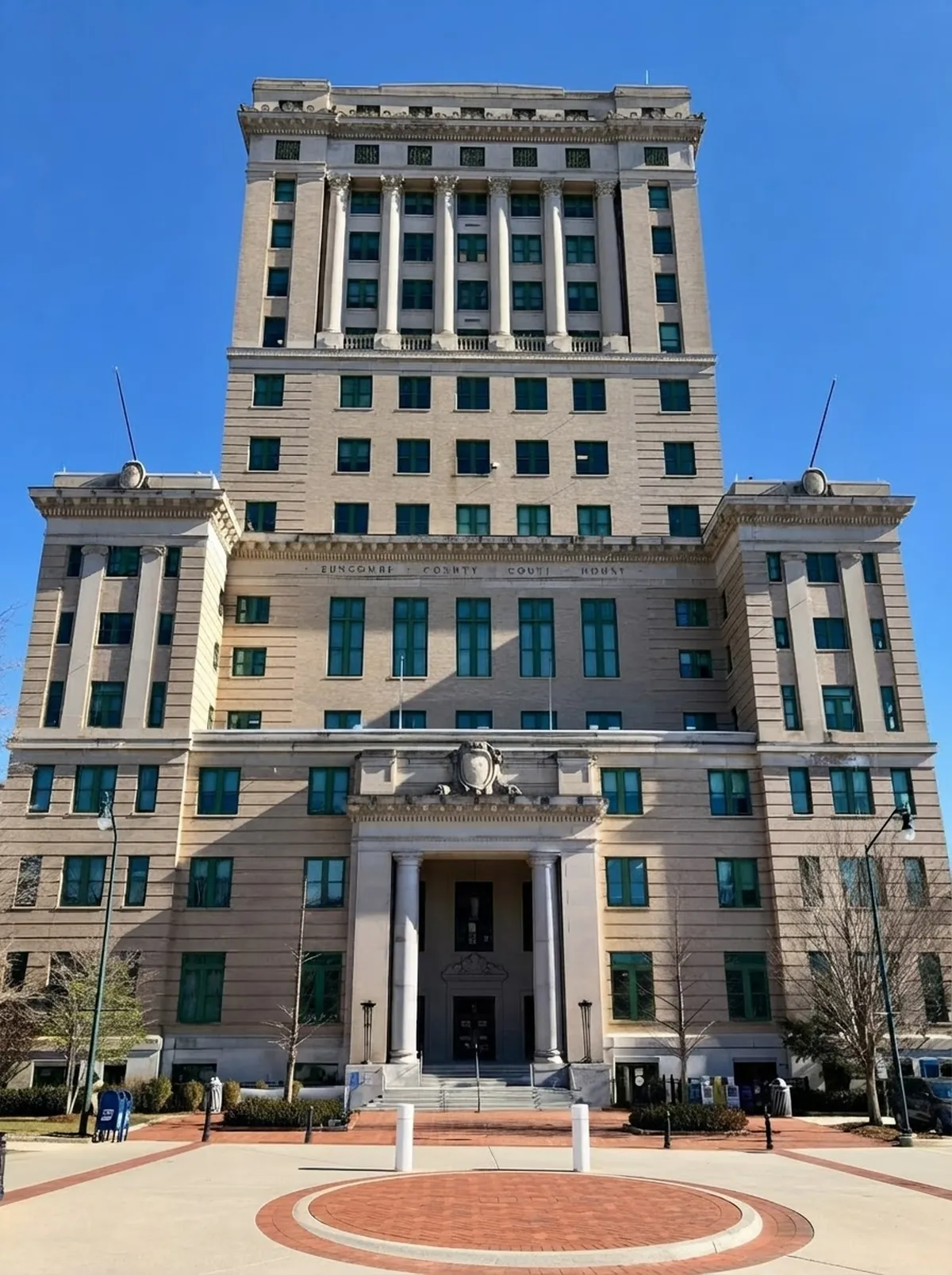
Court records in Buncombe County, North Carolina, are maintained by the Clerk of Superior Court and can be accessed through online tools, official court portals, and the clerk's office. BuncombeCourt.us can help you find publicly available court record information for Buncombe County. You can also search records through the North Carolina Judicial Branch court records portal, visit the Clerk of Superior Court's office in person, or contact other government agencies that maintain related public records.
Buncombe Court System Overview
Buncombe County is part of North Carolina Judicial District 28, which serves Buncombe County exclusively. The court system in Buncombe County includes both Superior Court and District Court divisions, each handling different categories of cases. Superior Court addresses felony criminal cases and civil matters above $25,000, while District Court handles misdemeanors, infractions, family law, juvenile matters, and civil cases up to $25,000. Magistrates operate within the District Court division, handling small claims, issuing warrants, and setting bail. The Buncombe County courthouse is located in Asheville.
Courts Serving Buncombe
| Court | Address | Phone |
|---|---|---|
| Buncombe County Superior Court | 60 Court Plaza, Asheville, NC 28801 | (828) 259-3400 |
| Buncombe County District Court | 60 Court Plaza, Asheville, NC 28801 | (828) 259-3400 |
| Buncombe County Magistrate's Office | 60 Court Plaza, Asheville, NC 28801 | (828) 259-3400 |
| U.S. District Court, Western District of North Carolina (Asheville Division) | 100 Otis Street, Asheville, NC 28801 | (828) 771-7200 |
| U.S. Bankruptcy Court, Western District of North Carolina | 100 Otis Street, Asheville, NC 28801 | (704) 350-7500 |
| Asheville Municipal Court (City of Asheville) | 100 Court Plaza, Asheville, NC 28801 | (828) 259-5400 |
What Types of Cases Buncombe Courts Hear
Courts in Buncombe County handle a broad range of case types across criminal, civil, and specialized divisions:
- Criminal: Felonies, misdemeanors, infractions
- Traffic: Moving violations, DWI/DUI
- Civil litigation: Contract disputes, personal injury, property disputes
- Small claims: Civil disputes up to $10,000
- Family law: Divorce, custody, child support, domestic violence protective orders, paternity
- Probate and estates: Decedent estates, guardianships, conservatorships
- Juvenile: Delinquency, undisciplined youth, abuse/neglect/dependency
- Adoption and termination of parental rights
District Court Cases in Buncombe
Buncombe County District Court hears misdemeanor criminal cases, infractions, and civil cases where the amount in controversy is $25,000 or less. District Court judges also preside over all family law matters—including divorce, custody, and domestic violence protective orders—as well as juvenile cases. When a felony case originates in District Court through a probable cause hearing, it is transferred to Superior Court for trial if the defendant is bound over or indicted by a grand jury. District Court judges are assigned to specific courtrooms and calendars, and cases are typically scheduled through the Criminal and Traffic Division or the Civil Division of the Clerk's office.
Magistrate Court Cases in Buncombe
Magistrates in Buncombe County serve as judicial officers within the District Court division. They handle small claims cases up to $10,000, issue arrest warrants and search warrants, conduct initial appearances, and set conditions of pretrial release. Magistrates also accept guilty pleas for certain minor offenses and perform civil marriage ceremonies. Under North Carolina law, small claims actions (formally called "summary ejectment" or "claim and delivery" in some contexts) are filed directly with the magistrate's office. If either party appeals a magistrate's judgment in a small claims or summary ejectment case, the matter moves to District Court for a new trial. Magistrates are available around the clock for warrant requests and emergency matters.
Family Law, Probate, and Juvenile Matters in Buncombe
Family Law: Divorce, child custody, child support, equitable distribution, paternity, and domestic violence protective order cases are heard in Buncombe County District Court. The North Carolina divorce packet provides forms and instructions for filing an absolute divorce. North Carolina requires at least one year of separation before a divorce can be granted.
Probate: The Clerk of Superior Court handles probate matters in Buncombe County, including estate administration, guardianship, and conservatorship proceedings. Estates are opened and administered through the Clerk's office, which also appoints guardians and conservators when needed.
Juvenile: Juvenile delinquency, undisciplined youth, and abuse/neglect/dependency cases are heard in District Court. Juvenile court records are confidential under North Carolina law and are not available to the general public. Contact the Clerk's office for questions about juvenile proceedings.
How Cases Move Through the Buncombe Court System
- Filing or initiation: Criminal cases begin with an arrest, citation, or magistrate's order. Civil cases start when a plaintiff files a complaint with the Clerk's office. Family and probate matters begin with a petition.
- Assignment: Cases are assigned to a courtroom and calendar. The Clerk's office manages scheduling for both criminal and civil dockets.
- Initial hearing: In criminal cases, the defendant appears for a first appearance or arraignment. In civil cases, a scheduling or pretrial conference may be set.
- Pre-trial phase: Parties exchange discovery, file motions, and may engage in plea negotiations (criminal) or settlement discussions (civil).
- Trial or resolution: Cases proceed to trial before a judge or jury, or resolve through a plea agreement, settlement, default judgment, or voluntary dismissal.
- Post-judgment: Criminal defendants may be sentenced and may appeal to the North Carolina Court of Appeals. Civil judgments can be enforced or appealed. Probate orders are carried out by the appointed fiduciary.
Court Administration, Local Rules, and Public Access in Buncombe
Courts in Buncombe County are administered by the Senior Resident Superior Court Judge and the Chief District Court Judge for Judicial District 28, supported by a Trial Court Administrator. Buncombe County local rules and forms are published by the North Carolina Judicial Branch and govern scheduling, motions practice, and courtroom procedures for both Superior and District Court.
Public access to records: Most court records in North Carolina are public under N.C. General Statutes Chapter 132 (Public Records Act) and the rules adopted by the Administrative Office of the Courts. Exceptions include juvenile records, sealed records, adoption files, and certain mental health proceedings. You can request a public record from the Judicial Branch online or visit the Clerk's office in person.
Attending hearings: Court sessions at the Buncombe County Courthouse are generally open to the public. Some proceedings may be conducted remotely; contact the Clerk's office to ask about electronic hearing availability for a specific case.
Court Records and Related Court Resources in Buncombe
- Court record search and case lookup: The North Carolina Judicial Branch court records portal lets you search for case information by name, case number, or county.
- Court dates and calendars: Use the Court Dates search tool to look up upcoming hearings by name, county, or date range.
- Court forms and self-help: The North Carolina court forms page provides statewide and local forms, including the eCourts Guide & File tool for preparing documents.
- Criminal background checks: The Clerk of Superior Court in Buncombe County can process a certified criminal background check by name for a single county.
- Criminal and traffic records: The Criminal and Traffic Division handles record checks, court appearance information, and expunction requests.
- Inmate and offender search: The Buncombe County Sheriff's Police to Citizen portal provides inmate inquiry tools. For state prison offenders, use the NC Department of Adult Correction offender search, which also covers probationers, parolees, and registered sex offenders.
- Vital records: Birth, death, and marriage certificates are available through the Buncombe County Vital Records office or the Register of Deeds vital records page. Divorce certificates can be obtained from the NC Vital Records office or the Clerk of Court in the county where the divorce was filed.
- Property and land records: The Buncombe County Register of Deeds maintains an online database of recorded deeds dating back to the late 1700s. The Land Records division and the Buncombe County GIS map offer parcel data and property research tools.
- Tax records: The Buncombe County Tax Lookup provides property assessment and tax bill information.
- Historical records: The Buncombe County Record Archive includes digitized tax assessor books, tax scrolls, and other historical documents.